
From Consensus to Commitment in Academic Decision-Making
In this article:
Why the academic norm of consensus — well-intentioned as it is — can quietly become decision paralysis, eroding trust and exhausting leaders
The critical distinction between voice, consensus, and commitment — and why commitment is the more durable goal
Three concrete steps leaders can take to redesign participation so decisions move forward without abandoning shared governance
For higher education to evolve and thrive in complex times, we need people across our institutions to move forward together. For leaders, this means recognizing when a longstanding cultural norm of consensus is holding their institutions back.

Across higher education, leaders take pride in making decisions “the right way.” They consult widely, listen carefully, and honor shared governance with the hope of creating consensus on a path forward. A desire for consensus is deeply rooted in academic culture, where many spend entire careers at their institutions. However, it can also lead to decision paralysis when deeply felt, strongly held positions are on both sides of a decision.
The problem with consensus
Let’s look at the largely unexamined assumption that good decisions require consensus.
Consensus emerged in higher education for good reasons. It helped protect academic voice, build trust, and guard against unilateral, top-down decision-making. However, over time, consensus has drifted from a means to an end in itself. In many institutions today, leaders feel compelled to keep conversations open long after the key trade-offs are clear. Difficult decisions get delayed to avoid discomfort. And too much focus on consensus may prevent people from sharing differing ideas and opinions. Quietly, and often unconsciously, this assumption is exhausting leaders and stalling meaningful progress. The result is not better governance, but decision paralysis.
Healthy academic cultures normalize disagreement without allowing it to derail progress. Leaders expect dissent and refuse to equate disagreement with disloyalty, allowing them to make decisions without being punitive. The goal is not harmony. It is forward motion with integrity.
In a previous blog, Disagreeing Together: Why discomfort is essential to academic leadership, we explored the dangers of decision-making without discomfort at a time when disagreement in academic life feels so much harder than it used to. When leaders work too hard to avoid discomfort, disagreement does not disappear; it simply goes underground. Decisions lack buy-in.
The differences between voice, consensus, and commitment
One of the most important distinctions in academic leadership is also one of the least explicit. Our Voice, Consensus, and Commitment framework, informed by both established research and our experience with clients, shows why these three elements are distinct yet closely connected:
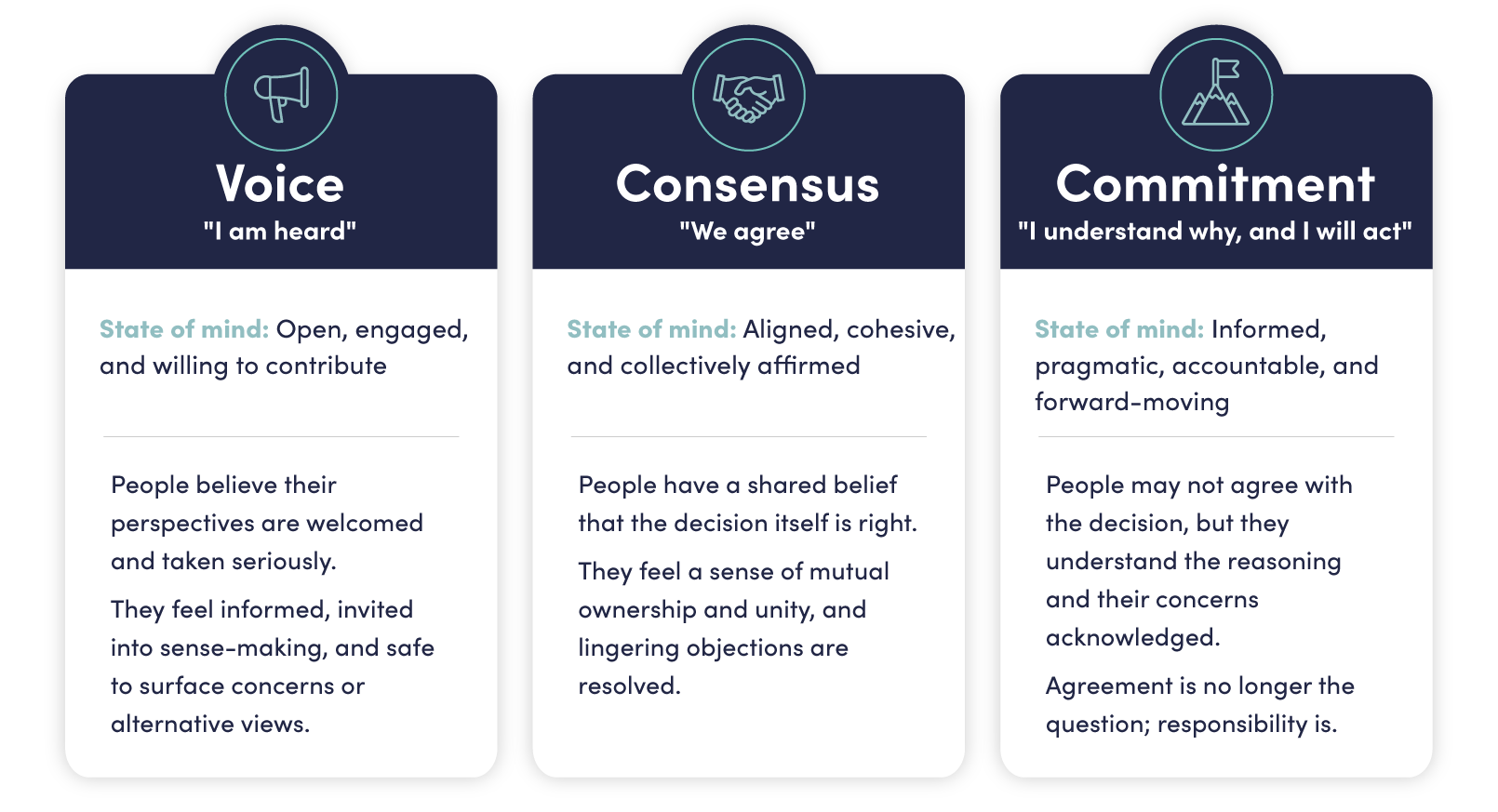
Voice is foundational to any type of true agreement. It means people have access to relevant information, meaningful opportunities to share perspectives, and a genuine chance to influence thinking before decisions are made. Voice is essential and non-negotiable in academic culture, but voice does not require agreement.
Consensus is one path to making decisions. It implies broad agreement with a decision, not merely an understanding of its rationale. Consensus processes often seek to resolve or incorporate dissent so that no significant objections remain, which typically requires multiple rounds of discussion and revision. While consensus prioritizes cohesion and shared ownership, it also demands time and sustained engagement. And, in the presence of deeply held differences, it can be difficult or impossible to reach. In practice, the result is often compromise rather than conviction, weakening engagement in the future state.
Commitment is a different path. Commitment means there is agreement that, despite differences, a decision has been made. It is often built by gaining buy-in, which means people understand the rationale for a decision and see their concerns reflected in it, even if the outcome is not their preferred one. At this point, roles and responsibilities become clear, and people act in alignment with the decision. Commitment requires that voice is heard and recognized. It requires a transparent decision-making process and leadership. When people have had a genuine opportunity to be heard and understand why a decision needs to be made, they are far more likely to commit.
Ensuring voice and shepherding effective decision-making processes is more important than ever. From financial pressure and regulatory change to enrollment volatility, higher education is confronting challenges that demand timely, coordinated action while also igniting values-based disagreement.
In today’s environment, waiting for consensus when, realistically, no decision will be made, not only prolongs processes but can also become inequitable. When decisions stall, the costs are absorbed unevenly across the institution through fragmented implementation, duplicated effort, and growing strain on staff and faculty asked to compensate for unresolved choices. Workarounds proliferate, accountability blurs, and cynicism takes hold.
Three steps to shift from consensus to commitment
Moving from consensus to commitment does not mean abandoning shared governance—it means making it more workable. Commitment requires clarity: clarity about where input will genuinely shape decisions, what constraints must be honored, and where authority ultimately resides.
Leaders build trust not by promising agreement, but by being explicit about how voice will be respected, and how decisions will be made. Ambiguity may feel collegial in the moment, but it creates false expectations, delays action, and ultimately erodes credibility. Using commitment as a decision-making approach allows institutions to act with integrity, alignment, and accountability, even in the absence of full consensus.
Shifting from consensus to commitment begins with leader behavior. Commitment is modeled, not mandated. Process design is a core leadership responsibility. Effective leaders do not improvise participation; they design it intentionally. Key steps are as follows:
1. Inviting input early. Leaders engage their colleagues before options harden, when perspectives can meaningfully shape direction rather than react to a near-final decision. Early voice builds trust and improves decision quality. To prepare for these conversations, try asking:
Who needs to be heard early to surface risks, assumptions, or unintended consequences?
What perspectives am I least comfortable hearing—and why might they be essential?
How can I frame the question so people respond with insight, not positions?
2. Using representative forums thoughtfully. Rather than seeking input from everyone on everything, effective leaders rely on well-designed representative structures that balance inclusivity with momentum. To prepare, ask yourself:
What forum is fit for purpose for this decision (committee, task force, advisory group, open forum)?
Who legitimately represents the affected groups, and who does not need to be at the table?
What decision rights does this group have: advise, recommend, or decide?
3. Closing the loop with transparency. Leaders explicitly communicate how input was considered, what trade-offs were made, what the decision is, and why the final decision took the shape it did. This step converts voice into commitment. To prepare, ask yourself:
How will I explain what I heard so people recognize their input?
What feedback influenced the decision, and what could not be incorporated?
What constraints or priorities guided the final decision?
How will I signal that the decision is now settled and requires commitment?
When participation is intentionally designed, people may not agree, but they understand the process, see their perspectives respected, and are more willing to act in alignment with the decision.
The benefits of gaining commitment
Leaders and institutions that make this shift experience tangible benefits. Execution becomes faster and more coherent. Roles and expectations are clearer. Leadership burnout decreases. Trust in governance processes grows. Most importantly, people know where they stand, and that clarity is deeply stabilizing in times of change.
Speed, when paired with transparency and integrity, is not the enemy of shared governance. In many cases, it is what allows shared governance to function as intended by preserving clarity, fairness, and institutional trust.
The question facing higher education is no longer, How do we get everyone to agree? It is, How do we ensure everyone is heard—and then move forward together? The future belongs to institutions that can make this shift with intention, transparency, and courage.
Making this shift — from consensus to commitment — is rarely a policy change. It is a leadership behavior change, and it takes practice. If you're working through this at your institution, ALG partners with academic leaders to build exactly this capacity. Let’s talk about what you are working on.
Interested in learning more about ALG and how we support higher education? Request a complimentary copy of our book, The Empowered Leader or sign up for our newsletter.